IN PURSUIT OF TRIVIA
DID YOU KNOW.......
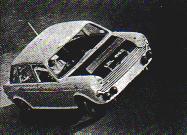
When you sit in the driver's
seat at night and the boot is open, a reflection of the boot light is
seen on the rear window?
The very first car made
by BMW was the Austin 7 built under licence and marketed as the Dixi?
(Try that on the next yuppie
BMW owner you meet.)
The Austin 7 was also built
under licence in the USA as the Bantam, and in Japan as a Datsun.
An aspect of Hydrolastic
suspension rarely mentioned is that it's the only springing medium that
tightens with speed, giving a soft ride at low speed and stable high speed
- even Mercedes / BMW ride like a dray at low speeds.
The overall weight of the
Austin1800's power unit complete, is 549 lbs / 250 kg.
This represents approx.
a fifth of the overall weight of the Landcrab (2,547 lbs. / 1,155 kg).
The Austin 1800 Freeway?...
apparently a certain number of Austin 1800 Mk ll 's were imported into
New Zealand from Australia but the sales figures fell short. To overcome
this and with arrangement with the Australian/New Zealand governments,
the remaining Mk ll's were re-badged and named 'Freeway'.
Freeway badges appeared
on the front grille, bonnet, boot lid and the steering wheel boss.
You can bolt a Mk l cylinder head
on to a Mk ll engine block... but cannot bolt a Mk ll head on to
a Mk l block. The reason for this is that the Mk ll block has small recesses
for the exhaust valves.
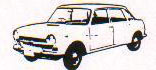
The Mk l Austin 1800 was
released in Australia on 22nd November 1965. This was followed by the
automatic version on 19th February 1968.
The utility (ute) followed
a few months later with a release date of 19th July 1968.
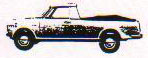
The tax inclusive price
for the 1800 ute at time of release was
Manual
$2,040
Automatic
$2,280
Basic
Cab/Chassis $1,992
The Mk ll version of the
Aussie Landcrab was released on the 25th October 1968.
Engine / Chassis Prefixes:
Although the Landcrab prototype
was known in the U.K. as ADO 17, such was not the case
in Australia. The Australian prototype was YDO 18.
MOWOG on BMC castings stands
for: MO - Morris, WO - Wolseley and G - MG.
How can you tell a late
model Mk ll from all other Mk ll's?
Answer: The
front indicator repeater light on the front mudguard is located beneath
the waistline whereas the earlier models are mounted above.
Oil Dipsticks: There are two
lengths - the manual dipstick is 17 5/8 inches (44.8 cm) long and the
automatic dipstick is 16.5 inches (41.9 cm) long. First Models in Britain
had wrongly calibrated dipsticks among other teething problems.
Rear Hubs: There are
two types of rear hubs on the 1800.
The Mk l is
tapered from the flange to the inside bearing end and the Mk ll is parallel.
The Mk l type will not fit a Mk ll fitted with PBR brakes as the flange
end of the taper fouls against the parking brake link. However the Mk
ll will fit a Mk l with no problems.
Registration Papers: Have you
ever wondered what all that YAH stuff meant when reading your engine number
on registration papers?
Here is the
explanation.
For example:
18YAH/TA/H101: 18 means it is
a 1798cc Austin; Y denotes Australian
origin; A for Austin;
H is H type
(1400cc-1999cc); a fourth letter can denote automatic; TA means standard
ratio remote control gearbox - transverse; H denotes the
engine as high compression; followed by the serial number.
Wheels: A 13 inch
wheel revolves 874 times per mile, while a 14 inch wheel revolves 821
times per mile, both at 30 m.p.h.
Body Styles: In Britain
some people had their last drive - in an Austin 1800 Hearse! There were
also estates (wagons) converted by Crayford of England.
In Australia
there were at least three A1800 Panel vans, produced for the RAN and used
as ambulances, and an Austin 1800 campervan conversion.
It was the first BMC car to have a separate fresh air ventilation system.
RALLY TRIVIA
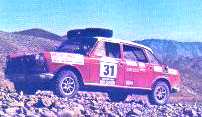
Evan Green's Austin 1800 on the Lataband Pass in Afghanistan. London - Sydney Marathon 1968
During the 1968 London-Sydney Marathon, Evan Green's 1800 (number 31), was one of the quickest cars down the Lataband Pass in Afghanistan, helped by a total loss of brakes! This car also had the fastest time from Menindee to Sydney, but only finished in twenty-first place.
Andrew Cowan's first victory in the
Southern Cross International Rally was in 1969, driving an Austin 1800.
His navigator was D. Johnson. (More about this on the
London-Sydney Marathon site.)
After the 1968
London - Sydney Marathon, Castrol announced the results of a competition
it had run to pick the first five placegetters. These were selected by
British motoring writers and team managers. The results included two 1800
drivers - Rauno Aaltonen (first) and
Evan Green (third).
Only one car
hit a kangaroo during the Australian section of the London - Sydney Marathon,
this was
Gelignite Jack Murray's 1800 and it happened very near Perth's suburbs.
Gelignite Jack Murray's 1800 and it happened very near Perth's suburbs.